

What Is SOC 2 Compliance? The Complete Guide for Founders (2026)
TL;DR
SOC 2 is a voluntary audit framework created by the AICPA that evaluates how well your organization protects customer data across five Trust Service Criteria. It's not a pass/fail certification — it's an independent report issued by a licensed CPA firm. For SaaS companies selling to mid-market or enterprise buyers, SOC 2 has become a de facto requirement that can make or break deals. Type I audits cost $5,000–$20,000 and take 1–3 months; Type II runs $12,000–$50,000 over 6–12+ months. With AI-powered compliance platforms, preparation timelines and costs have dropped dramatically — making SOC 2 achievable even for seed-stage startups.
Key Concept: SOC 2 Compliance
Reading Time: 11 minutes
Difficulty: Beginner
Relevant for: SaaS Founders, CTOs, Startup Operations Leaders
TL;DR
SOC 2 is a voluntary audit framework created by the AICPA that evaluates how well your organization protects customer data across five Trust Service Criteria. It's not a pass/fail certification — it's an independent report issued by a licensed CPA firm. For SaaS companies selling to mid-market or enterprise buyers, SOC 2 has become a de facto requirement that can make or break deals. Type I audits cost $5,000–$20,000 and take 1–3 months; Type II runs $12,000–$50,000 over 6–12+ months. With AI-powered compliance platforms, preparation timelines and costs have dropped dramatically — making SOC 2 achievable even for seed-stage startups.
Why You're Probably Googling This
You just got off a sales call. The prospective customer — the one with the six-figure contract — asked the dreaded question:
"Are you SOC 2 compliant?"
If you're the CEO or CTO of a growing SaaS business, this probably isn't the first time you've heard it. And it won't be the last. As data breaches make headlines weekly and enterprise buyers tighten their vendor requirements, SOC 2 compliance has become the trust signal that separates serious vendors from everyone else.
Here's what makes that question uncomfortable: most founders know SOC 2 matters, but few understand what it actually involves, what it costs, or how long it takes. This guide gives you a clear, jargon-free breakdown of everything you need to know — from the five Trust Service Criteria to realistic budgets and timelines — so you can make an informed decision about when and how to pursue SOC 2.
What Is SOC 2 Compliance?
SOC stands for System and Organization Controls. SOC 2 is a framework created by the AICPA (American Institute of Certified Public Accountants) to evaluate how well a service organization handles customer data based on five Trust Service Criteria.
One common misconception: SOC 2 is not a certification you pass or fail. It's an audit conducted by an independent CPA firm that produces a detailed report. That report describes your controls, how they were tested, and whether the auditor found any exceptions. You share this report with customers and partners to demonstrate your security posture.
Think of it this way. ISO 27001 is a certification — you either have the certificate or you don't. SOC 2 is an attestation — a CPA firm attests to what they observed about your controls, and the reader decides how much confidence that gives them.
There are two types of SOC 2 reports:
- Type I: Evaluates whether your controls are properly designed at a specific point in time — a snapshot.
- Type II: Evaluates whether those controls actually worked effectively over a period of time (typically 3–12 months).
Most companies start with Type I to establish initial credibility, then progress to Type II — which carries significantly more weight with enterprise buyers. For a deeper comparison, see our SOC 2 Type I vs Type II guide.
The Five Trust Service Criteria
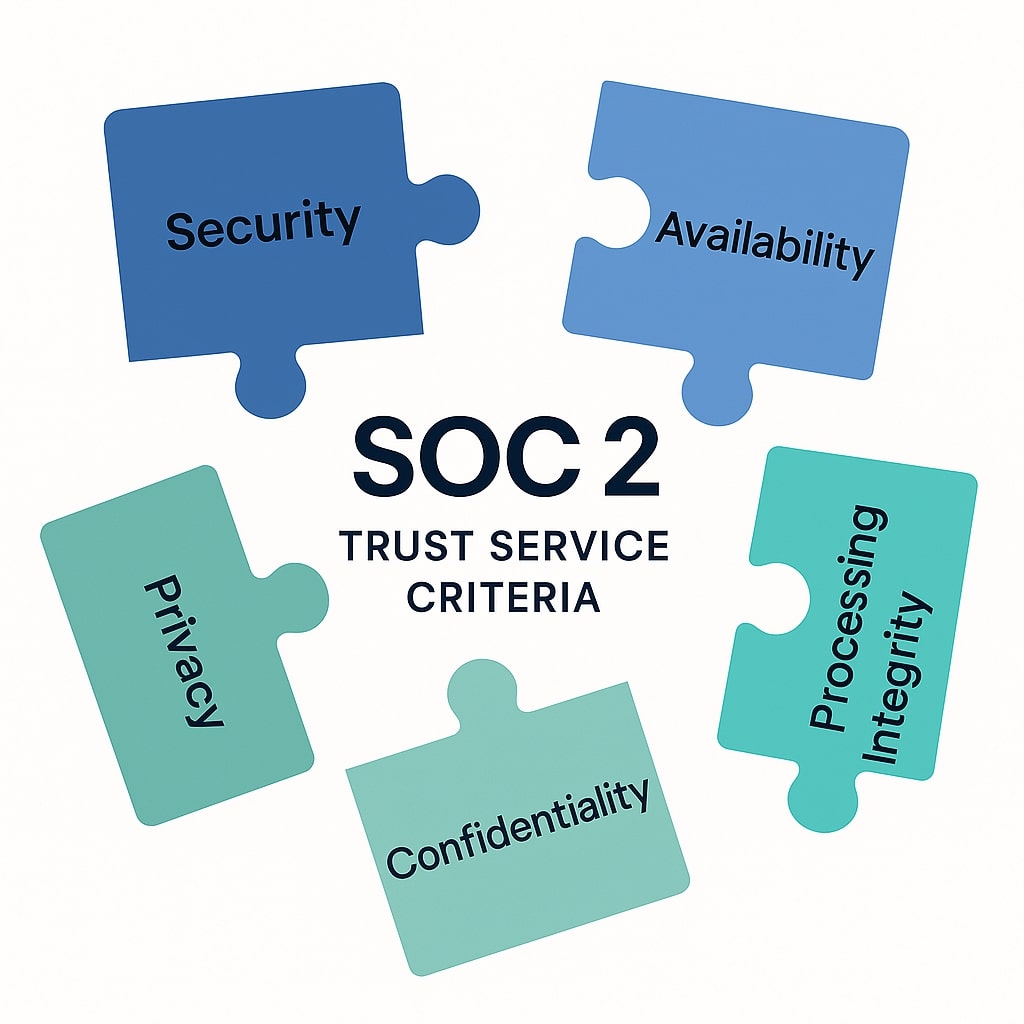
Every SOC 2 audit is built around five categories. Security is always required. The other four are optional — you choose which ones to include based on your service model and what your customers expect.
1. Security (Required — Common Criteria)
This is the foundation of every SOC 2 audit. The Common Criteria (CC1–CC9) cover protection against unauthorized access to your systems and data. In practice, this means demonstrating controls like multi-factor authentication, network firewalls, intrusion detection, encryption at rest and in transit, and formal access provisioning and de-provisioning processes. Every other Trust Service Criterion builds on this baseline.
2. Availability
This criterion evaluates whether your systems are available for operation and use as committed or agreed. Think uptime SLAs backed by real infrastructure: redundant hosting, disaster recovery plans, capacity monitoring, and incident response procedures. If you're a SaaS company promising 99.9% uptime, auditors will want to see how you actually deliver on that promise. Read more in our guide to Availability and Processing Integrity.
3. Processing Integrity
System processing should be complete, valid, accurate, timely, and authorized. This matters most for companies handling financial transactions, data transformations, or automated workflows where errors could have real consequences. Controls here include input validation, error handling, reconciliation processes, and quality assurance testing.
4. Confidentiality
Information designated as confidential is protected as committed. This goes beyond basic security — it covers data classification policies, encryption of sensitive data, restricted access based on the principle of least privilege, and secure disposal of confidential information when it's no longer needed.
5. Privacy
Personal information is collected, used, retained, disclosed, and disposed of in conformity with your privacy commitments. If you handle personally identifiable information (PII), this criterion demonstrates you have proper consent management, data retention policies, and individual rights procedures in place. Companies subject to GDPR, CCPA, or similar regulations often include this criterion.
Which criteria should you choose? Most first-time companies start with Security alone or Security plus Availability. Adding criteria increases audit scope and cost, so be strategic. Ask your target customers which criteria matter to them — that's the most reliable way to decide.
Who Actually Needs SOC 2?
SOC 2 isn't legally required for anyone. No regulator will fine you for not having one. But the market has made it a de facto requirement for entire categories of businesses.
You almost certainly need SOC 2 if you're a SaaS company selling to mid-market or enterprise customers, a cloud service provider or managed service provider handling customer infrastructure, a fintech company processing financial data, or a healthtech company handling protected health information (often alongside HIPAA). HR tech platforms, data analytics providers, and any company that stores, processes, or transmits customer data in a B2B context will increasingly face SOC 2 requirements as they move upmarket.
The trigger is usually a sales conversation. According to recent industry surveys, 52% of B2B buyers now raise security in their very first interaction with a potential vendor, up from 28% in 2023. And 34% of organizations report losing business specifically because they were missing a required security certification. If you're hearing "Are you SOC 2 compliant?" more than once a quarter, it's costing you revenue to not have an answer.
Ready to Streamline Your Compliance?
Discover how Humadroid can simplify your compliance management process.
How the SOC 2 Audit Process Works
Getting SOC 2 compliant is a project that touches your technology, your processes, and your people. Here's how to approach it without drowning in complexity:
- Define your scope. Identify which systems, services, and teams will be included in your audit. Map where customer data lives, who interacts with it, and what infrastructure supports it. Tighter scope means faster, cheaper audits — don't include systems that don't touch customer data.
- Build your policies and controls. You'll need documented policies for access control, incident response, change management, risk assessment, vendor management, and more. These aren't theoretical documents — they need to reflect how your company actually operates. AI-powered platforms can generate company-specific policies in minutes rather than weeks.
- Collect evidence. Evidence is the lifeblood of your audit: access logs, configuration screenshots, process documentation, HR onboarding records, training completions, and vendor assessments. The more automated your evidence collection, the easier your audit will be.
- Run a readiness assessment. Think of this as a mock audit. It's your chance to identify gaps before an external auditor finds them. Companies that skip this step face a 40–60% gap rate in their controls during the actual audit. See our SOC 2 readiness assessment guide for the full process.
- Choose a CPA firm. Only a licensed CPA firm can issue a valid SOC 2 report. Look for firms with experience in your industry and company size — Big Four firms charge $40,000–$100,000+, while specialized boutique firms often deliver quality reports for $5,000–$20,000.
- Close gaps and complete the audit. After fieldwork, there may be remediation work: fixing broken processes, improving documentation, or implementing missing controls. Once that's done, you receive your final SOC 2 report.
For a detailed walkthrough of each step, use our SOC 2 Audit Checklist. Need to do this without a dedicated security team? That's increasingly common — here's how: SOC 2 Without a Security Team.
How Much Does SOC 2 Cost?
Cost is the question every founder asks second (right after "do we really need this?"). The answer depends on your company size, the type of report, and whether you use consultants, automation tools, or go fully DIY.
Here's a realistic cost breakdown for a small to midsize SaaS company:
| Cost Component | Type I Range | Type II Range |
|---|---|---|
| Readiness assessment | $5,000–$15,000 | $5,000–$15,000 |
| Remediation & gap closure | $2,000–$15,000 | $5,000–$25,000 |
| CPA audit fees | $5,000–$20,000 | $12,000–$50,000 |
| Compliance tools / platform | $1,500–$30,000/yr | $1,500–$30,000/yr |
| Total first-year estimate | $13,500–$80,000 | $23,500–$120,000 |
Traditional consulting firms can push the total well beyond $100,000 annually. That's a real problem for startups — 37% of organizations spend between $100,000 and $200,000 on compliance audits each year according to the A-LIGN 2024 Compliance Benchmark.
The good news: AI-powered compliance platforms have collapsed these costs dramatically. Where a compliance consultant charges $15,000–$30,000 just for the readiness assessment, platforms like Humadroid offer comprehensive compliance management — from AI-generated policies to automated evidence collection — starting at $125/month. That's the difference between compliance being a financial burden and compliance being a business investment.
How Long Does SOC 2 Take?
Timelines vary based on your starting point and the type of report you're pursuing:
- Type I: 1–3 months total (preparation + audit). If you're starting from scratch with no documented policies, expect the longer end. With a compliance automation platform, some companies achieve Type I readiness in as little as 2–4 weeks.
- Type II: 6–15 months total. This includes the preparation phase plus a mandatory 3–12 month observation period where your controls must be operating effectively. The observation period cannot be compressed — it's the whole point of Type II.
Industry data tells a consistent story: 56% of organizations spend 3–6 months in the preparation phase alone. But companies using compliance automation report reducing that preparation time by roughly 40%. The smart move for most startups is to pursue Type I to unblock immediate deals, then begin the Type II observation period the same week. See our SMB decision framework for help choosing.
SOC 2 vs. ISO 27001 vs. HIPAA: Which Do You Need?
SOC 2 isn't the only compliance framework you'll encounter. Here's how the three most common ones compare:
| SOC 2 | ISO 27001 | HIPAA | |
|---|---|---|---|
| Created by | AICPA | ISO/IEC | U.S. Congress |
| Type | Attestation (report) | Certification | Legal requirement |
| Mandatory? | Voluntary (market-driven) | Voluntary | Required for covered entities |
| Geographic focus | Primarily North America | Global | United States |
| Best for | SaaS, cloud services, B2B | Global operations, EU markets | Healthcare data |
| Control overlap | SOC 2 and ISO 27001 share approximately 80% control overlap |
Many growing companies end up needing both SOC 2 (for North American customers) and ISO 27001 (for European or global markets). The significant control overlap means pursuing both simultaneously is more efficient than tackling them sequentially. Healthcare SaaS companies typically need SOC 2 plus HIPAA — see our detailed SOC 2 vs. HIPAA comparison.
Common SOC 2 Mistakes to Avoid
After working with dozens of companies preparing for their first SOC 2 audit, the same mistakes come up again and again:
- Scoping too broadly. Including every system in your audit increases cost and timeline. Focus on systems that store, process, or transmit customer data. Everything else is noise.
- Underestimating documentation. Documentation is roughly 50% of audit work. Having great security controls means nothing if you can't prove they exist through written policies, procedures, and evidence. Start documenting early.
- Skipping the readiness assessment. Going straight to the formal audit without a gap analysis is like taking a final exam without studying. First-time candidates face a 40–60% gap rate — a readiness assessment catches those gaps when they're cheap to fix.
- Treating SOC 2 as a one-time project. Your SOC 2 report expires after 12 months. Customers will ask for updated reports. If you let your controls lapse between audits, the next one becomes exponentially harder. Build year-round compliance habits from the start.
- Ignoring vendor management. Your security is only as strong as your weakest vendor. SOC 2 auditors will examine how you assess and monitor third-party service providers. Build a vendor risk assessment process before the audit, not during it.
Benefits of SOC 2 Compliance
SOC 2 isn't just a checkbox for enterprise sales. Done right, it transforms how your business operates:
- Unblock revenue. 76% of organizations now use SOC 2 as their primary audit framework when evaluating vendors, making it the most commonly requested attestation. Without it, you're excluded from a growing segment of deals before the conversation even starts.
- Shorten sales cycles. Instead of spending weeks responding to custom security questionnaires, you hand over your SOC 2 report. Procurement teams get the assurance they need, and your deal closes weeks faster.
- Build investor confidence. SOC 2 compliance signals operational maturity. For companies approaching Series A or B, having a SOC 2 report removes a common due diligence concern and demonstrates you're building for the long term.
- Reduce breach risk. The average cost of a data breach reached $4.44 million in 2024. SOC 2 controls — access management, encryption, monitoring, incident response — directly reduce the likelihood and impact of security incidents.
- Strengthen internal operations. The audit process forces you to formalize policies, define roles, document procedures, and build accountability. Most companies report that their operations improve significantly just from going through the process.
For a deeper look at why starting early pays off, see 18 Reasons to Become SOC 2 Compliant Early.
What Happens After the Audit?
Many teams see SOC 2 as a finish line. It's not. It's a starting point.
SOC 2 reports are typically valid for 12 months, and customers will request updated reports on a regular cycle. Type II requires continuous evidence that your controls are operating effectively — you can't let things slide for 10 months and then scramble before the next audit.
Effective post-audit compliance means weekly evidence checks, monthly access reviews, and quarterly internal assessments. Organizations that invest in automated evidence collection and daily compliance guidance stay audit-ready without the last-minute scramble. Our year-round compliance monitoring checklist breaks this into a manageable routine.
Tools like Humadroid help you maintain policy acknowledgments, track evidence collection, manage vendor assessments, and get daily compliance guidance — so your next audit is a confirmation of what you're already doing, not a fire drill.
Want to stay audit-ready without drowning in spreadsheets? See how Humadroid helps startups achieve and maintain SOC 2 compliance at a fraction of the traditional cost.
February 2026 update: This guide has been expanded with detailed Trust Service Criteria explanations, current cost breakdowns and timelines based on 2024–2025 industry benchmarks, a SOC 2 vs ISO 27001 vs HIPAA comparison framework, common preparation mistakes with practical solutions, and updated statistics on SOC 2 adoption trends and market requirements.
Frequently Asked Questions
Type I audits typically take 1–3 months total (preparation plus audit). Type II takes 6–15 months because it includes a mandatory 3–12 month observation period. Industry data shows 56% of organizations spend 3–6 months in the preparation phase alone, though companies using compliance automation platforms report cutting preparation time by roughly 40%. Starting from scratch with no documented policies will take longer than building on existing security practices.
For a small to midsize SaaS company, total first-year costs typically range from $13,500–$80,000 for Type I and $23,500–$120,000 for Type II. CPA audit fees alone run $5,000–$20,000 for Type I and $12,000–$50,000 for Type II, with Big Four firms charging significantly more. Traditional consulting approaches can push annual compliance costs to $100,000–$200,000+. AI-powered platforms like Humadroid have reduced the non-audit costs dramatically — offering comprehensive compliance management starting at $125/month compared to $15,000–$30,000 for a consultant's readiness assessment alone.
Many startups do, especially with modern automation tools. The key is having someone own the process, using frameworks like SOC 2 or ISO 27001 as guides, and maintaining consistent documentation. Compliance automation platforms provide the structure and guidance that previously required consultant expertise.
SOC 2 Type 1 is a snapshot audit that evaluates your security controls at a specific point in time, while Type 2 examines how effectively those controls operated over a period of 3-12 months. Type 2 audits are more comprehensive and carry greater weight with enterprise customers, as they demonstrate sustained compliance rather than just a momentary assessment.
AI-powered platforms like Humadroid can generate SOC 2 policies, controls documentation, and evidence collection templates in minutes rather than weeks, at $125-250/month versus $200k+ annually for traditional consultants. The AI provides 24/7 guidance through the entire compliance process, automatically tracking your progress and identifying gaps before the audit.
No. SOC 2 is a voluntary audit framework — no law or regulation requires it. However, enterprise buyers, investors, and procurement teams increasingly treat it as a de facto requirement. According to industry surveys, 76% of organizations use SOC 2 as their primary framework when evaluating vendors. If you sell B2B SaaS to mid-market or enterprise customers, not having SOC 2 will cost you deals.
Technically, no — SOC 2 is an attestation, not a pass/fail certification. The auditor issues a report describing your controls and noting any exceptions (areas where controls weren't operating as designed). However, a report with significant exceptions is effectively a failure in the eyes of customers and prospects. That's why running a readiness assessment before the formal audit is critical: it catches gaps early when they're cheap to fix.
Only a licensed CPA (Certified Public Accountant) firm can issue a valid SOC 2 report. Internal teams and non-CPA consultants can help you prepare, but the actual audit must be conducted by an independent CPA firm. Look for firms experienced in your industry and company size — Big Four firms charge $40,000–$100,000+, while specialized boutique firms often deliver quality reports for $5,000–$20,000.
If you sell B2B software and your customers store or process sensitive data through your platform, you likely need SOC 2. The clearest signal is sales friction: if prospects are asking "Are you SOC 2 compliant?" during the sales process, it's already costing you revenue. SaaS companies, cloud providers, fintech platforms, and healthtech companies are the most common candidates. With AI-powered compliance platforms reducing costs to under $3,000/year, even seed-stage startups can now pursue SOC 2 without breaking the budget.
SOC 2 reports are generally considered valid for 12 months. Most enterprise customers will request an updated report annually, and some may ask more frequently. For Type II reports, the audit covers a specific observation period (3–12 months), and you'll need to start the next observation period promptly to avoid gaps in coverage. Building continuous compliance habits — automated evidence collection, regular access reviews, and policy updates — makes each renewal cycle significantly easier than the first.


