

9 Internal Company Policies Examples You Should Implement (+ Templates)
TL;DR
Generic company policy templates fail because they don't match how startups actually operate, leading to 40% of organizations failing their first ISO 27001 certification and costing $10,000-$100,000+ in audit remediation. Instead of using outdated Fortune 500 templates, companies should create AI-powered, context-specific policies that reflect their actual tech stack, team size, and industry requirements. This guide covers the 9 essential internal company policies every business needs, provides a reusable policy template framework you can apply to any policy, and includes 3 bonus compliance-critical policies that SOC 2 and ISO 27001 auditors specifically look for.
TL;DR
Generic company policy templates fail because they don't match how startups actually operate, leading to 40% of organizations failing their first ISO 27001 certification and costing $10,000-$100,000+ in audit remediation. Instead of using outdated Fortune 500 templates, companies should create AI-powered, context-specific policies that reflect their actual tech stack, team size, and industry requirements. This guide covers the 9 essential internal company policies every business needs, provides a reusable policy template framework you can apply to any policy, and includes 3 bonus compliance-critical policies that SOC 2 and ISO 27001 auditors specifically look for.
Stop Using Generic Policy Templates: 9 Internal Company Policies That Actually Match Your Startup (Not Amazon's)
Company policies aren't bureaucracy. They're business hygiene. And if you want to grow without chaos, you need them early. But here's what nobody tells you: 60-68% of data breaches involve human factors (Verizon 2024-2025), often because employees follow generic policies that don't match how your company actually works.
Most policy templates are useless. They're 50-page Word docs written for Fortune 500 companies that you awkwardly try to edit for your 12-person SaaS startup. According to McKonly & Asbury's 2024 analysis, documentation deficiencies are the most common reason for SOC 2 audit issues. That's why 40% of organizations fail their first ISO 27001 certification attempt—they're using policies that don't reflect reality.
Meanwhile, 85% of companies say compliance has become more complex in the past three years (PwC 2025), and 69% of organizations find regulations too complex or too numerous to manage effectively. You need policies that work for YOUR company. Not policies that look impressive in a binder nobody reads.
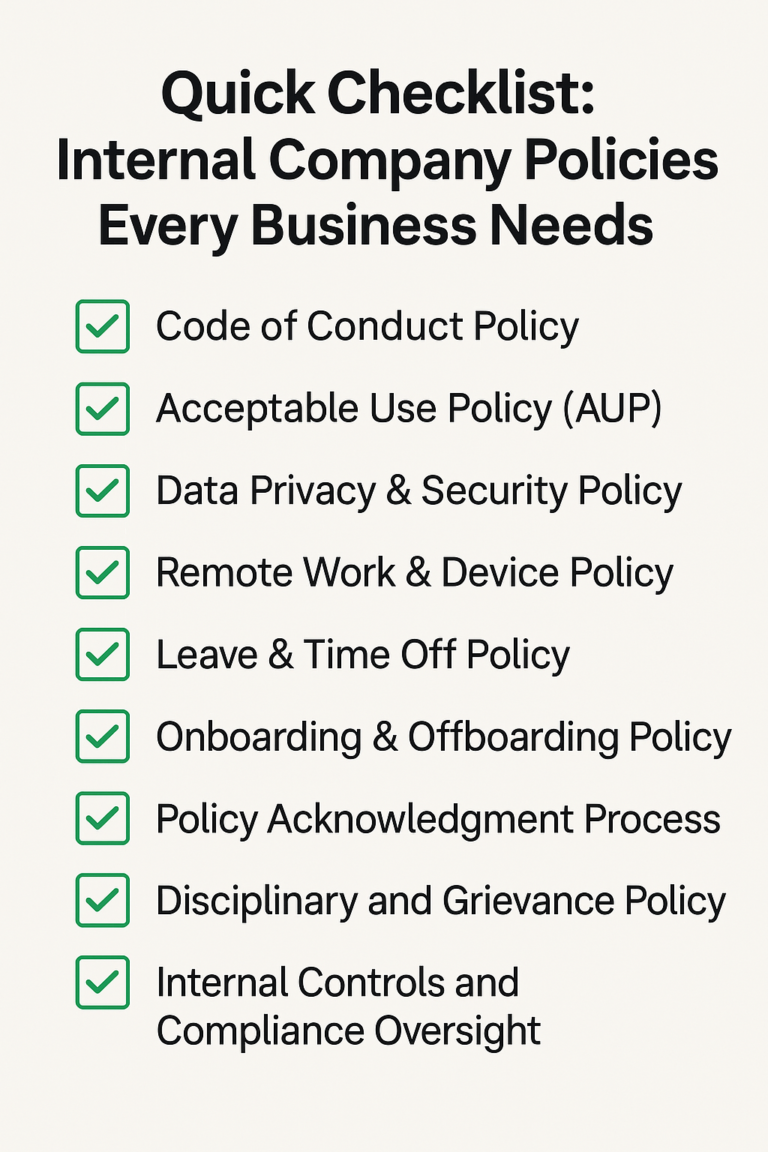
What Are Company Policies and Why Generic Templates Fail
Company policies are formal statements that define expectations for how people behave, how processes work, and how your company aligns with laws and internal standards. But here's the problem: 97% of cloud apps used in enterprises are shadow IT (Netskope 2024), meaning your "no unauthorized software" policy is already being violated by nearly everyone.
Well-structured, context-aware company policies do more than prevent problems—they:
- Match your actual tech stack (Slack, not "electronic communications")
- Reflect your team size (no 5-layer approval chains for 10-person startups)
- Address your industry requirements (HIPAA for healthtech, PCI DSS for fintech)
- Scale with your growth (what works at 10 employees fails at 50)
- Actually get followed because they make sense
The Hidden Cost of Generic Templates
Audit remediation costs range from $10,000 to $100,000+ when policies don't match reality (Bright Defense 2025). Why? Because auditors immediately spot the disconnect:
- Your policy mentions "office hours" but you're fully remote
- It requires "department head approval" but you don't have departments
- It references "IT service desk" when that's just Dave on Slack
How AI Changes the Policy Game
Instead of starting with a generic template, what if your policies were generated based on YOUR context?
🤖 Example: Traditional Template vs AI-Generated Policy
Generic Template Says: "Employees must follow proper information security protocols when handling company data."
AI-Generated for 10-Person B2B SaaS Says: "All team members with access to customer data in PostgreSQL production databases must use hardware 2FA tokens. Customer data exports from Metabase require a documented business reason in a Linear ticket, approved by either the CTO or Head of Customer Success."
See the difference? One is lawyer-speak. The other is actionable.
Company Policy Template: A Reusable Framework for Any Policy
Before diving into the 9 essential policies, here's a universal template structure you can apply to any company policy. Whether you're writing an acceptable use policy or an asset management policy, this framework ensures consistency, auditability, and clarity.
Most policy templates you'll find online give you a wall of legal text. That's backwards. A good company policy template starts with structure, not content. The content should be generated to match your specific context—your team size, your tech stack, your industry.
The 7-Section Company Policy Template
Every effective internal policy should follow this structure:
1. Policy Header
- Policy name and unique identifier (e.g., POL-SEC-001)
- Version number and effective date
- Policy owner (name and role, not just "management")
- Next review date
- Approval authority
2. Purpose & Scope
- Why this policy exists (one paragraph, plain language)
- Who it applies to (employees, contractors, vendors?)
- What systems, data, or processes it covers
3. Definitions
- Define any term that might be ambiguous
- Use YOUR company's terminology, not generic corporate speak
- Example: "Production environment" means our AWS us-east-1 region running customer-facing services
4. Policy Statements
- Clear, specific rules written as actionable requirements
- Each statement should be testable ("How would an auditor verify this?")
- Use "must" for mandatory requirements, "should" for recommendations
- Include the tools and systems by name
5. Roles & Responsibilities
- Who does what—by role, not by name (people change, roles persist)
- Escalation paths for violations or questions
- Who has authority to grant exceptions
6. Compliance & Enforcement
- How compliance is monitored (automated checks, manual audits, both)
- Consequences for violations (progressive discipline reference)
- Exception request process
7. Review & Revision History
- Change log with dates, authors, and what changed
- Scheduled review frequency (quarterly for fast-changing areas, annually for stable ones)
- Trigger events requiring immediate review
Template Tips That Auditors Love
After reviewing thousands of policies across SOC 2 and ISO 27001 audits, here's what separates audit-ready policies from checkbox exercises:
Be specific about tools. "Employees must use approved communication channels" fails. "Internal communications use Slack (company workspace). Customer communications use Zendesk or company email. No customer data in personal messaging apps" passes.
Make every statement testable. Ask yourself: "If an auditor asked me to prove this, what would I show them?" If you can't answer that question, the policy statement is too vague.
Version everything. Auditors need to see which version an employee acknowledged. Unversioned policies are effectively unauditable. Humadroid's Compliance Daily feature tracks exactly which policy versions need attention on any given day, so nothing slips through the cracks.
🤖 AI Advantage: Instead of manually filling in this template for each policy, AI can generate the entire document based on your company context. Tell it your company size, tech stack, and industry—and get a complete, audit-ready policy in minutes rather than weeks. Try generating your first policies free.
How to Create a Company Policy (Updated for 2026)
Forget the old framework. Use this AI-powered approach:
- Define your context – Company size, industry, tech stack, remote status
- Generate the base – AI creates policy matching YOUR reality
- Review with stakeholders – Does this match how we actually work?
- Add your specifics – Unique processes, tool names, approval chains
- Set up tracking – Digital acknowledgment with timestamps
- Schedule reviews – Quarterly for fast-growing startups, annually for stable companies
Last Updated: February 2026 | Major Updates: Added reusable company policy template framework, 3 bonus compliance-critical policies, refreshed 2025-2026 statistics, expanded FAQ section
Why Company Policies Matter Before You Scale
Most startups and small businesses delay writing internal company policies until something goes wrong—a legal issue, an HR dispute, or a compliance audit. But consider this: organizations using security AI and automation save $1.9 million per breach compared to those without (IBM 2025). Even if you never have a breach, that risk reduction affects your valuation and insurance costs.
New Reality Check: With 40% of workers now remote or hybrid (McKinsey 2024), your policies can't assume everyone's in the same building. And with employees using an average of 730 cloud services while IT only knows about 51 (Netskope), your policies better address the tools people actually use, not the ones you wish they'd use.
The compliance landscape isn't getting simpler, either. 81% of organizations now report current or planned ISO 27001 certification—up from 67% in 2024 (A-LIGN 2025). That means your competitors are documenting their policies properly. If you're not, you're falling behind in enterprise sales conversations.
Clear, context-aware company policies:
- Set realistic expectations that match your actual operations
- Reduce the 60-68% of breaches involving human error
- Build trust by being transparent and practical
- Make onboarding actually useful (not a checkbox exercise)
- Satisfy auditors who've seen every generic template already
Think of them as your internal operating system. And the earlier you write them for YOUR company (not some imaginary enterprise), the easier they are to scale.
Ready to Streamline Your Compliance?
Discover how Humadroid can simplify your compliance management process.
9 Internal Policies Examples (With What Auditors Actually Check)
1. Code of Conduct Company Policy
A Code of Conduct is one of the most important company policies you can establish. It outlines expected behavior in the workplace—how people interact, what's acceptable, and how violations are handled. But auditors don't just want to see you have one—they check if employees actually know it exists.
What Auditors Look For:
- Signed acknowledgments from 100% of employees (not 87%)
- Evidence of annual training or refreshers
- Actual disciplinary actions when violations occur
- Specific examples relevant to your industry
Key elements (Updated for Modern Teams):
- Respectful communication across all platforms (Slack, GitHub comments, Zoom)
- Remote work professionalism (background noise, camera policies)
- Social media guidelines that reflect your actual company culture
- Clear escalation paths that don't require finding HR (you might not have HR)
- Specific examples of violations in YOUR context
🤖 AI Advantage: Generate examples specific to your tools. Instead of "inappropriate electronic communications," get "Unprofessional conduct includes using reaction emojis sarcastically in Slack, leaving passive-aggressive comments in pull requests, or discussing customer data in personal Discord servers."
Pro tip: Link this to your incident reporting channel—whether that's a Typeform, dedicated Slack channel, or email alias.
2. Acceptable Use Company Policy (AUP)
This company policy governs how employees use company devices, tools, and data. With 80% of employees using shadow IT (Cisco), your AUP needs to address reality, not wishful thinking.
What Auditors Look For:
- List of approved AND commonly-requested tools
- Clear process for requesting new software
- Evidence you actually monitor compliance
- BYOD (bring your own device) guidelines if applicable
Key elements (Shadow IT Reality Edition):
- Approved alternatives to common shadow IT (use Notion, not personal Evernote)
- AI tool guidelines (90% of organizations already have or are building an AI-compliance policy per A-LIGN 2025)
- Personal device usage rules that people will actually follow
- Password manager requirements (specific: use 1Password/Bitwarden, not "use strong passwords")
- Cloud storage rules (company Google Drive, not personal Dropbox)
🤖 AI Advantage: Auto-generate approved tool lists based on your tech stack. "Marketing team can use Canva Pro (company account), not personal Adobe Creative Cloud. Engineering must use GitHub Copilot (company seats), not personal ChatGPT Plus for code generation."
Common risk: Average enterprise uses 1,265 cloud apps (Netskope). Your policy better address more than just Office 365.
3. Data Privacy & Security Company Policy
If your company collects, stores, or processes personal or customer data, you need a clear policy to stay compliant. The global average cost of a data breach hit $4.88 million in 2024 (IBM)—a 10% increase over the prior year and an all-time high.
What Auditors Look For:
- Specific data classification levels (public, internal, confidential, restricted)
- Encryption requirements for data at rest and in transit
- Actual implementation evidence (not just the policy)
- Breach notification procedures with timeline
Key elements (With 2026 Requirements):
- GDPR Article 32 technical measures if you have EU customers (total GDPR fines have reached ~€5.65 billion as of early 2025)
- State-specific requirements (CCPA, CPRA, Virginia's CDPA)
- AI data usage policies (where can customer data go?)
- Incident response procedures (organizations that detect breaches internally save $1 million — IBM)
- Data retention schedules by data type
🤖 AI Advantage: Generate policies that match your actual data flows. "Customer PII from Stripe webhooks must be encrypted in PostgreSQL using AES-256. Zendesk tickets containing PII auto-delete after 24 months per GDPR requirements."
Use this company policy to support your external privacy statements and stay aligned with regional data protection laws.
4. Remote Work & Device Company Policy
54% of workers prefer remote work but only 40% have it (McKinsey 2024), creating tension that policies must address. Generic "remote work permitted with manager approval" doesn't cut it anymore.
What Auditors Look For:
- Home network security requirements
- Device encryption and MDM enrollment
- Clear availability expectations
- Cross-border data handling rules
Key elements (Distributed Team Reality):
- Timezone coverage requirements (who's on call when?)
- Home office security (encrypted WiFi, no public networks for customer data)
- VPN requirements for specific activities (accessing production, not everything)
- Equipment policies (company provides, employee expenses, or BYOD?)
- Meeting recording policies (some states require consent)
🤖 AI Advantage: Adjust by location. "California employees receive $150/month home office stipend per state law. Texas employees can expense up to $500 for home office setup. EU employees cannot access customer PII from home networks without VPN."
Align this company policy with your Acceptable Use and Security policies.
Need Compliance Policies for Your Business?
Skip the blank page. Generate custom, context-aware policies instantly with our free AI-powered policy generator—tailored to your company size, industry, and tech stack.
Generate Free Policy Templates
5. Leave & Time Off Company Policy
Even small teams need clarity around time off. Without it, confusion leads to burnout or internal disputes. "Unlimited PTO" sounds great until auditors ask how you ensure minimum rest periods for compliance.
What Auditors Look For:
- Documented approval processes
- Minimum time off enforcement for unlimited PTO
- Compliance with local laws (varies dramatically by state/country)
- Coverage plans for critical roles
Key elements (That Scale):
- Minimum PTO requirements (even for "unlimited"—suggest 2 weeks minimum)
- Sabbatical policies for retention (more common in 2025+)
- Mental health days (separate from sick leave)
- Coverage requirements by role
- Local law compliance matrix
🤖 AI Advantage: Auto-generate based on employee locations. "California employees accrue 1 hour sick leave per 30 hours worked. UK employees receive 28 days statutory holiday. Remote employees in Colorado must receive public holiday equivalents."
Pro tip: Make this visible in your HRIS and require acknowledgment for international hires.
6. Onboarding & Offboarding Company Policy
People join and leave your company. That process should be structured—for the sake of security, compliance, and experience. Access revocation within 24 hours is now table stakes; auditors expect 2-4 hours.
What Auditors Look For:
- Access provisioning/revocation checklists with timestamps
- Evidence of actual timely deprovisioning
- Return of equipment tracking
- Knowledge transfer documentation
Key elements (Security-First Approach):
- Day -7: Background check, reference verification, equipment ordering
- Day 0: Account provisioning per role-based matrix (no "give them what Sarah has")
- Day 1: Security training before system access
- Day 30: Access review and adjustment
- Offboarding: 2-hour SLA for access revocation, 24-hour for device remote wipe
🤖 AI Advantage: Generate role-specific checklists. "Frontend Developer: GitHub read access Day 1, write access after first PR approval. AWS console never. Datadog read-only after security training completion."
This company policy supports IT, HR, and compliance alignment—tools like Humadroid can automate the tracking.
7. Company Policy Acknowledgment Process
Having company policies isn't enough—you need to prove that people saw and accepted them. Organizations using automated tracking achieve 87.5% to 99% acknowledgment rates (Xoralia 2024), while manual tracking rarely exceeds 60%.
What Auditors Look For:
- Timestamp records of acknowledgment
- Version control (who acknowledged which version)
- Follow-up for non-acknowledgments
- Annual re-acknowledgment evidence
Key elements (Automation Required):
- Digital signatures with legal validity
- Automated reminders for non-compliance
- Dashboard showing completion rates by department
- Integration with onboarding workflows
- Version tracking for policy updates
🤖 AI Advantage: Smart reminders based on role. "Engineers must re-acknowledge Acceptable Use Policy quarterly due to production access. Marketing re-acknowledges annually. New ChatGPT guidance triggers immediate re-acknowledgment for all staff."
Without proper tracking, you can't prove compliance. Tools like Humadroid automate acknowledgment tracking with AI-powered updates when policies change.
8. Disciplinary and Grievance Company Policy
To ensure fair treatment and minimize legal risks, every company should outline how it will handle disciplinary action and employee grievances. This protects both employees and leadership when conflict or performance issues arise.
What Auditors Look For:
- Progressive discipline evidence (warnings before termination)
- Documentation of all incidents
- Consistent application across similar violations
- Appeals process that actually works
Key elements (Practical for Small Teams):
- What triggers immediate termination vs progressive discipline
- Documentation requirements (written warnings, not just Slack DMs)
- Investigation process for complaints (even with no HR department)
- External escalation options (especially for complaints about founders)
🤖 AI Advantage: Scale-appropriate processes. "Teams under 20: CEO and one board member review all terminations. Teams 20-50: Form temporary review committee. Teams 50+: Formal HR process required."
A clear process helps avoid escalation—and proves you acted fairly if challenged.
9. Internal Controls and Compliance Oversight Policy
47% of organizations say keeping policies current with regulations is their #1 challenge (NAVEX Global 2024). This policy ensures someone's actually responsible for maintaining all your other policies.
What Auditors Look For:
- Named policy owners (not "management")
- Review schedules with evidence of actual reviews
- Change logs showing what updated and why
- Board or leadership review evidence
Key elements (The Meta-Policy):
- Quarterly review schedule for fast-changing policies (data privacy, AI use)
- Annual certification for stable policies
- Trigger events requiring immediate review (new regulations, incidents, tool changes)
- Clear ownership matrix (who owns what)
- Budget allocation for compliance tools
🤖 AI Advantage: Automated monitoring for changes. "When GDPR guidance updates, automatically flag Data Privacy policy for review. When new state passes privacy law, generate compliance gap analysis. When you add a new tool, update relevant sections across all policies."
Add structure now, and avoid scrambling later during audits or funding rounds. If you're pursuing ISO 27001, the ISMS Workbook maps every governance requirement from Clauses 4-10 and automatically links your existing policies as evidence—so your internal controls oversight is built into the system from day one.
Beyond the Core 9: 3 Compliance-Critical Policies Auditors Love to See
The 9 policies above form your foundation. But if you're preparing for SOC 2 or ISO 27001 certification—or if an enterprise customer is running a security questionnaire—these three additional policies will set you apart. They demonstrate maturity that goes beyond the basics, and auditors specifically check for them.
10. Change Management Policy
Every time you push code, update a server, or change a configuration, you're introducing risk. A Change Management Policy defines how changes are proposed, reviewed, approved, and documented. Over 30,000 new security vulnerabilities were identified in 2024 alone—a 17% year-over-year increase—making controlled change processes non-negotiable for compliance.
What Auditors Look For:
- Documented change request and approval workflows
- Separation of duties (the person requesting a change isn't the one approving it)
- Rollback procedures for failed changes
- Evidence that changes are tested before production deployment
Key elements for modern teams:
- Change categories (standard, normal, emergency) with different approval paths
- Pull request requirements: code reviews, automated tests, staging deployment
- Infrastructure changes tracked through IaC (Terraform, Pulumi) with version control
- Emergency change procedures (who can approve a hotfix at 2 AM?)
- Change advisory board—or for small teams, a designated reviewer per system
🤖 AI Advantage: Generate change management workflows sized for your team. "Teams under 15: All production changes require one peer review and CTO approval via GitHub PR. Infrastructure changes require a Terraform plan review in the #infra Slack channel. Emergency hotfixes can be approved by any senior engineer with post-deployment review within 24 hours."
SOC 2 connection: Change management maps directly to SOC 2 Common Criteria CC8.1 (Changes to Infrastructure, Data, Software, and Procedures). Without this policy, expect auditor findings.
11. Security Awareness Training Policy
You can write perfect policies, but they're worthless if your team can't recognize a phishing email. A third of employees click on simulated phishing links before receiving training (KnowBe4 2025). That drops by 86% after 12 months of ongoing training. Yet nearly half of all employees still receive no security training at all.
What Auditors Look For:
- Documented training schedule (not just "annual" but specific dates and topics)
- Completion records with timestamps for every employee
- Phishing simulation results and improvement trends
- Role-specific training for high-risk positions (finance, IT admins)
Key elements for real-world effectiveness:
- New hire training within first week—71% of new hires are more likely to click phishing links in their first 90 days
- Quarterly refreshers (not just annual checkbox exercises)
- Simulated phishing campaigns with measurable failure rates
- Role-specific modules: finance team learns about BEC scams, engineers learn about supply chain attacks
- Clear consequences for repeated failures (additional training, not punishment)
🤖 AI Advantage: Adaptive training based on risk. "After Maria in finance clicked 2 of 3 simulated phishing emails, auto-enroll her in the advanced social engineering module. Engineering team maintains a 95% detection rate—schedule their refresher quarterly instead of monthly."
Why it matters now: AI-generated spear phishing achieved a 54% success rate in controlled testing in late 2024, matching human-crafted attacks. By March 2025, AI-powered phishing was 24% more effective than human-created campaigns. Your team needs training that keeps pace with this reality.
12. Asset Management Policy
You can't protect what you don't know you have. An Asset Management Policy tracks every piece of hardware, software, and data asset in your organization—from the CEO's laptop to the forgotten S3 bucket with customer exports from 2023.
What Auditors Look For:
- Complete inventory of hardware and software assets
- Asset ownership assignments (every asset has an owner)
- Lifecycle tracking from procurement to secure disposal
- Regular inventory reconciliation (at least quarterly)
Key elements for growing companies:
- Hardware tracking: laptops, phones, monitors, security keys—with serial numbers and assignment records
- Software inventory: licensed tools, SaaS subscriptions, open-source dependencies
- Data asset classification: which databases contain PII, where backups live, who has access
- Disposal procedures: disk wiping standards, certificate of destruction for hardware
- BYOD asset boundaries: what's company data on a personal device, and how is it protected?
🤖 AI Advantage: Auto-generate asset categories based on your infrastructure. "AWS assets: 3 production RDS instances (customer data—confidential), 2 staging environments (test data—internal), 14 S3 buckets mapped by data classification. GitHub: 23 private repositories, 2 public. Hardware: 12 MacBook Pros deployed, 3 in storage, 1 pending disposal."
ISO 27001 connection: Asset management is covered under Annex A.5.9 (Inventory of Information and Other Associated Assets) and A.5.10 (Acceptable Use of Information and Other Associated Assets). It's one of the first things auditors verify during a Stage 1 audit. Learn more about Annex A controls.
The AI Difference: Context-Aware Policies That Actually Work
These twelve company policies—9 essential plus 3 compliance-critical—form the backbone of a well-run organization. But here's what makes 2026 different: you don't have to start from scratch OR use generic templates.
AI-powered policy generation means:
- 10-person startup policies look different from 50-person scaleup policies
- Fintech policies include PCI DSS requirements healthtech policies don't need
- Remote-first policies address different risks than office-based policies
- Your actual tech stack appears in the policy (not generic "company systems")
Start with AI-generated versions that match your context, then refine based on your unique needs. As you grow, AI helps evolve your policies—what worked at Series A won't work at Series C.
And once your policies are in place, keeping them alive is the real challenge. That's where tools like Humadroid's Compliance Daily come in—instead of wondering which policies need review, you get a daily action plan that tells you exactly what needs attention and why. It's the difference between compliance as a quarterly scramble and compliance as a 15-minute daily habit.
Ready to see what your policies should actually look like? Generate your first three policies free with Humadroid—just tell some brief details about your company. No generic templates. Just policies that match YOUR company.
Need Compliance Policies for Your Business?
Skip the generic templates. Generate custom, audit-ready policy documents tailored to your company size, industry, and tech stack—free.
Generate Free Policy Templates
Last Updated: February 2026 | Questions about specific compliance requirements? Email us at support@humadroid.io
What Changed in This Update:
- Added a reusable company policy template framework with 7-section structure for creating any internal policy
- Added 3 compliance-critical bonus policies: Change Management, Security Awareness Training, and Asset Management
- Refreshed statistics with 2025-2026 data from IBM, Verizon DBIR, A-LIGN, KnowBe4, and NAVEX Global
- Expanded FAQ section with template-focused and compliance-specific questions
- Added guidance on connecting policies to SOC 2 Common Criteria and ISO 27001 Annex A controls
- Included links to new Humadroid features: Compliance Daily dashboard and ISMS Workbook
Frequently Asked Questions
Internal company policies are formal rules and procedures that define how your organization operates—from employee behavior and data handling to access control and incident response. They serve as your company's operating manual, providing legal protection, building trust with customers and investors, and ensuring operational consistency as you scale.
Requirements vary by country and industry, but most jurisdictions require anti-discrimination, health and safety, and data protection policies. If you handle EU customer data, GDPR compliance policies are mandatory. In the US, state-specific requirements vary significantly—California alone has dozens of employment-related policy requirements. SOC 2 and ISO 27001 certifications require additional documented policies around information security, access control, and incident management.
A strong Code of Conduct includes behavioral expectations, anti-harassment guidance, reporting mechanisms for misconduct, and clear disciplinary consequences. For modern teams, it should also cover digital communication standards (Slack, GitHub, Zoom), social media guidelines, and AI tool usage expectations. Make it specific to your company—generic codes of conduct are the first thing auditors flag.
Start with the 7-section template framework: Policy Header, Purpose & Scope, Definitions, Policy Statements, Roles & Responsibilities, Compliance & Enforcement, and Review History. Define your company context first (size, industry, tech stack), then use that context to generate specific, actionable policy statements. AI-powered tools like Humadroid's free policy generator can create a complete first draft in minutes based on your company profile.
At minimum, annually for stable policies. But fast-changing areas—data privacy, AI usage, security—should be reviewed quarterly. Additionally, trigger events should prompt immediate review: regulatory changes, security incidents, new tool adoption, significant team growth, or audit findings. Set calendar reminders or use automated compliance tools that flag policies approaching their review date.
A company policy template provides the structure and format for creating policies—think of it as the skeleton. A company policy is the complete, finalized document with specific rules, responsibilities, and enforcement mechanisms tailored to your organization. The best approach is to use a consistent template framework across all your policies for uniformity, then fill each one with context-specific content. Generic pre-written templates from the internet often fail audits because they don't reflect how your company actually operates.
There's significant overlap, but each framework has unique requirements. SOC 2 focuses on Trust Service Criteria and requires policies mapping to Common Criteria like CC6.1 (access controls) and CC8.1 (change management). ISO 27001 requires policies mapping to Annex A controls plus the governance requirements in Clauses 4-10. Most companies pursuing both can maintain a single set of policies that satisfies both, with framework-specific mapping documented in their compliance platform.
For a seed-stage startup (under 10 employees), start with the essential 5: Code of Conduct, Acceptable Use Policy, Data Privacy & Security Policy, Onboarding/Offboarding Policy, and Policy Acknowledgment Process. As you grow toward 20-50 employees or begin SOC 2/ISO 27001 preparation, add Change Management, Security Awareness Training, and Asset Management policies. By Series A, you should have all 12 policies documented and tracked.
You can use them as a starting point, but never submit them as-is for an audit. Auditors have seen every generic template and will immediately spot the disconnect between a Fortune 500 policy template and your 15-person startup. The biggest risk is policies that reference procedures, tools, or organizational structures you don't actually have. At minimum, customize every policy to reflect your actual tech stack, team structure, and operational reality. Better yet, use AI-powered generators that create policies based on your specific company context from the start.
A practical company policy template includes 7 sections: a header with versioning and ownership info, purpose and scope, key definitions, specific policy statements (the rules), roles and responsibilities, compliance and enforcement mechanisms, and revision history. The template should be consistent across all your policies for auditability, but the content within each section must be specific to the policy topic and your company.


